
Why Data-Driven Organisations Still Make Poor Strategic Decisions
Introducing Decision Design: The connecting layer between strategy and analytics.

Over the last decade, organisations have invested billions in becoming data-driven. Yet many leaders still recognise the paradox of having world-class analytics teams while repeatedly making poor strategic decisions.
So what does it mean to be data-driven? If analytics produces technically excellent work but the organisation continues to fail due to poor strategic decisions, can we really call ourselves data-driven?
The problem isn’t analytics itself but where analytics enters the decision-making process. “Should we launch product A or B”, “Where can we cut costs”, “What customer is likely to churn next?”. The majority of questions analytics answers today fall into one of two categories: testing a hypothesis or predicting an outcome.
The real gap is that, somewhere upstream, the organisation has already decided what hypothesis should be tested or what outcome should be optimised for.
“Should we launch product A or B” assumes launching new products is the problem worth solving. “Where can we cut costs” assumes that cost cutting, not revenue or reallocating investments, is what we should optimise for. With poor strategic decisions, analytics will correctly answer the wrong question.
These upstream decisions are rarely structured with the same rigour that we expect from downstream analysis.
Decision Design brings scientific rigour to the design of strategic decisions by combining executive judgement, optimisation science and analytics.
This is the first article in a series introducing Decision Design where I lay out the foundations of the framework. Future pieces will explore the details of the framework, its limits and its applications across hiring, customer strategy, policy and personal decision-making.
Introducing Decision Design
Put simply, Decision Design takes high-level business questions and transforms them into optimisation problems.
Every decision can ultimately be broken down into three questions: What we care about, what we can change and what we cannot compromise on.
These three questions align with the concept of objectives, choices and constraints which is the core structure of a mathematical optimisation problem.
For example, a company might seek to maximise revenue (the objective) through cost-cutting and product expansion (the available choices) while continuing to meet regulatory standards (the constraints).
Decision Design combines three disciplines:
Executive judgement from business leaders;
The mathematical rigour of optimisation;
The evidence and estimation provided by analytics.
How the Elements Work Together
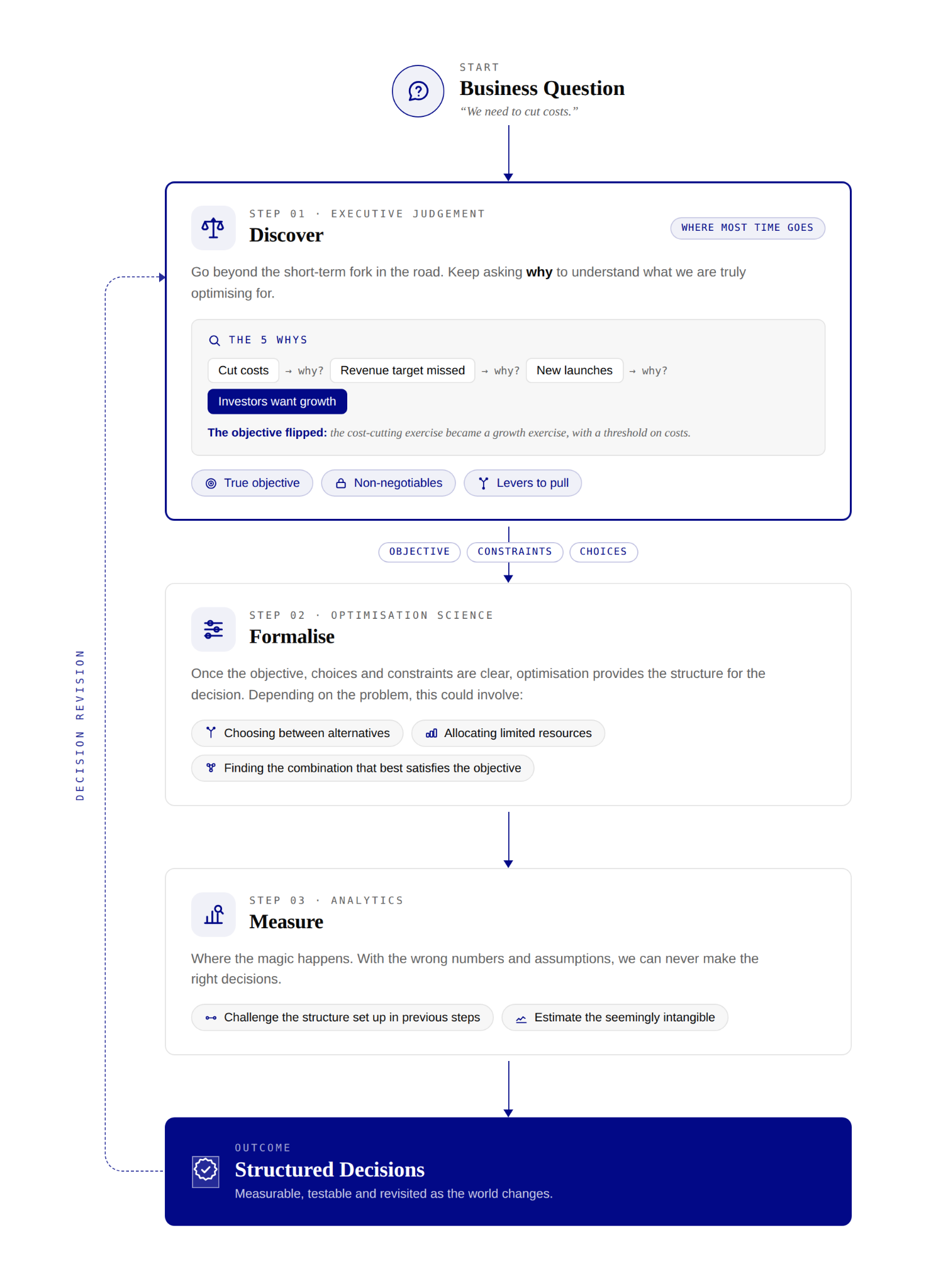
1. Discover What Actually Matters
This is by far the most important part of Decision Design and typically where most of the work happens.
The goal of this step is to help leaders to go beyond the short-term fork in the road and understand what we are truly optimising for by asking a series of “whys”. For example, a question may begin as “We need to cut costs.” Asking why may reveal that growth was below target, that recent product launches underperformed, and ultimately that investors expect stronger growth.
The objective has shifted from reducing costs to restoring growth. Cost may instead become a constraint: maximise growth while keeping spending below an acceptable threshold.
We want to leave this step with a clear understanding of our true objective, what we cannot compromise on and what choices are available to us.
Before Decision Design, the company’s question was: Where can we cut costs?
After Decision Design, the decision becomes: How should we reallocate investment across the three product lines to maximise sustainable growth without exceeding the annual cost ceiling?
That reframing changes the decision space from broad cost reduction to a more targeted choice: reduce investment in the weakest product, protect the stable revenue line and redirect resources towards the product with the strongest incremental return.
2. Formalise the Decision
Once the objective, choices and constraints are clear, optimisation provides the mathematical structure for the decision. Depending on the problem, this could involve choosing between alternatives, allocating limited resources or identifying the combination of decisions that best satisfies the objective while respecting the constraints.
3. Test and Measure the Decision
Analytics tests the assumptions embedded in the decision structure and estimates the quantities needed to compare choices. For example, if the objective in hiring is to retain high-performing employees, does requiring a specific certification actually predict performance or retention three years later? It also estimates the seemingly intangible. How might we estimate a candidate’s conflict-resolution skills, or quantify the risk of a public scandal?
Decision Design in Action
Decision Design can be used wherever organisations need to allocate scarce resources, balance competing objectives or make decisions under constraints – which is almost everywhere.
Over the coming months, I will explore topics such as:
Hidden Constraints Are Rejecting Your Best Candidates
The Loyalty Discount: Why Customer Patience Is One of Business’s Most Wasted Resources
Beauty Is a Resource Allocation Problem: Where Should You Spend to Look and Feel Better?
Designing Product Launches Around Cultural Trends: When should trends become an optimisation variable instead of lucky timing?
Building Cities That Outlive Elections: What happens when the objective lasts 30 years, but the decision-maker only has four?
Each article will examine a different flavour of Decision Design. Some will lean heavily on analytics and optimisation. Others will explore how executive judgement, incentives and constraints shape decisions that mathematics alone cannot resolve.
My hope is that you’ll begin to recognise Decision Design problems in your own work and perhaps even in your own life. I’m excited to hear where you see them and how you choose to apply the framework.
My name is Rosebud. I’ve been a Data Scientist for over a decade, and over that time I’ve gone from answering complex data questions to becoming increasingly interested in whether we’re asking the right questions. How do we decide what the right question is? And how do we bring the scientific rigour we expect from analytical execution to the decisions that drive that execution?
I’m writing about an approach I call Decision Design—the use of executive judgement, optimisation science and analytics to bring scientific rigour to strategic decision-making.